Building in public outgrew screenshots.
We are building three surfaces for founders to share real, verified metrics. Here is the thinking behind the Founder Wall, and what ships in a couple of weeks.
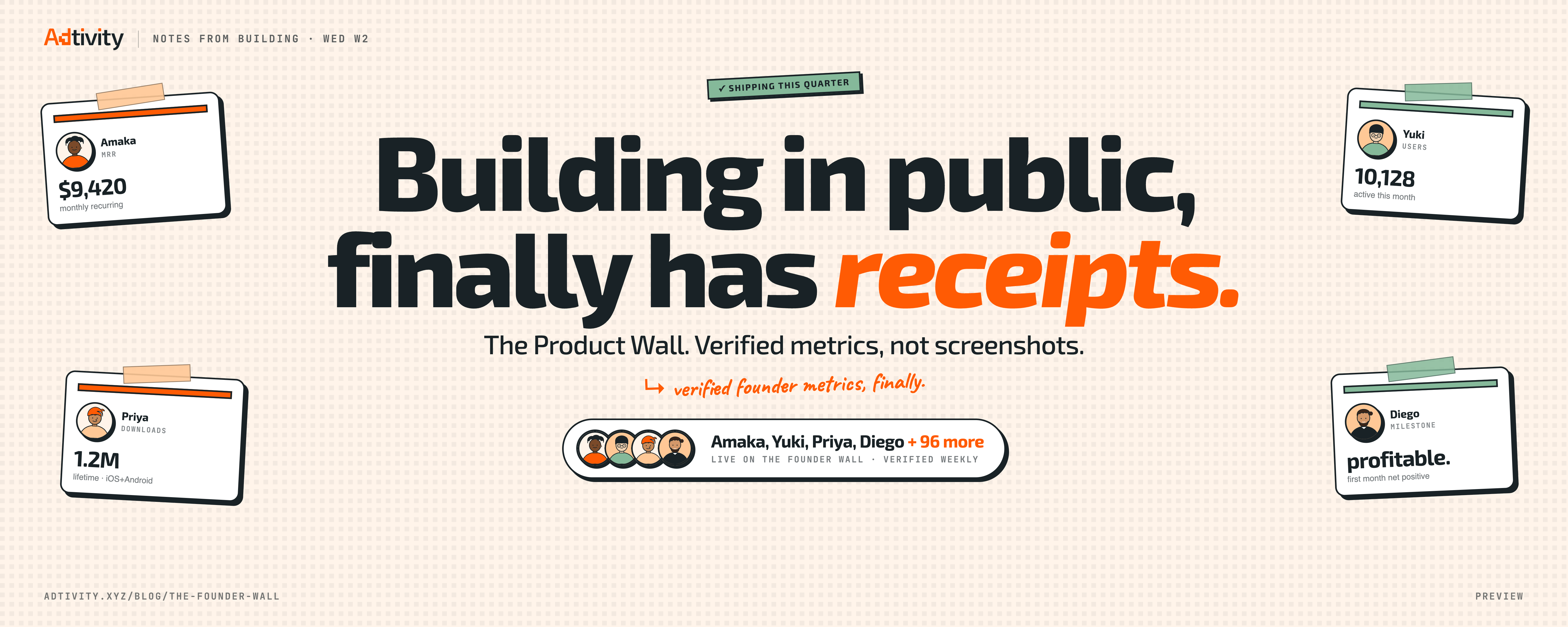
There is a screenshot almost every founder has taken. You hit a number you are proud of, your revenue, your user count, your downloads, the first month you finished in the green, and you do the thing everyone does. You crop it, you post it, and you wait. I [Jae] have done it. You have probably done it. For a few years now that screenshot has been the currency of building in public, the thing a founder holds up to say this is real, I am actually doing this.
It is also the weakest possible proof. A screenshot can be edited in a browser console in under a minute, the number carries no history and no context, and nothing in the image ties it to the person who posted it. We have built an entire culture of transparency on top of an artifact anyone can fake in sixty seconds. That gap is what the Founder Wall is for.
Building in public stopped being a vibe and became a skill
Somewhere in the last few years, building in public went from a thing a handful of indie hackers did to something close to a requirement. Alex Hormozi turned the public teardown of his own numbers into a media engine. Marc Lou shipped product after product in the open and put the revenue on display for each one. Naval Ravikant made transparency sound like a first principle rather than a marketing tactic. Cluely broke down its product, its build steps and its marketing where everyone could watch.
The result is that sharing your metrics is now a skill founders are expected to have, and how well you do it reads as a signal of how serious you are. Investors check it, customers check it, other founders check it. A founder who builds quietly in 2026 is not being humble, they are being invisible.
The tooling never caught up
Here is the part nobody fixed. The skill became essential, but the tooling stayed at screenshot-and-tweet. You do the real work of growing something, and then you do a second, separate job of manually packaging it: cropping the image, writing the caption, remembering last month's number so you can claim the delta. It is fiddly, it is easy to get wrong, and because it is all manual it is trivially easy to fake.
Some people did start fixing it. Baremetrics built Open Startups, where a subscription business connects its billing data and opts into a public dashboard that updates in real time. Marc Lou built TrustMRR in about 48 hours after a viral tweet about fake MRR screenshots, and it lets a founder connect a read-only Stripe key to publish a revenue page nobody can doctor. Both of them saw the same gap we did, and both started closing it. We are not claiming we invented this. We are saying the idea is right, and it deserves to go further than a single public number.
What we are building: three Walls
So we are building it into Adtivity directly, as three surfaces.
The Founder Wall is your identity as a founder. Think of it as a Linktree for everything you have built, except the links carry live, verified metrics instead of just a name. Every product you have shipped, with its real numbers attached to you, in one place. It is how a founder stops being a name and starts being a track record.
The Product Wall is a single product seen honestly. It is the verified-metrics page for one thing you have built, the layer that simply says this is real. It is the surface we are putting the most build weight behind, because it is the proof unit everything else is made of.
And The Wall is the leaderboard. It ranks companies by the numbers that actually matter, revenue, growth stage, user count, and it turns all of those individual proof units into something you can browse. It is where a founder gets discovered, where a good product stops being a secret, and where the honest version of the startup ranking finally exists.
Why none of it can be faked
All of this only works if the numbers are true, so that is the part we did not compromise on. The metrics on your Wall are not typed in. They are pulled straight from the source, your payment processor or your on-chain data, and they stay wired to it. The Wall does not show you a number you reported, it shows you a number your data reported, and you cannot edit that any more than you can edit your bank statement by squinting at it.
That is the whole difference between a Wall and a screenshot. A screenshot is a claim, a Wall is a connection. One you can fake in a console, the other you would have to fake your payment processor itself to fake.
Why now
We could have built this a year ago and it would have landed softer. What changed is the sheer number of founders. AI has compressed the distance between an idea and a working product so hard that there is a new one every day, and a real share of them will get genuinely big. The building-in-public wave is not slowing down, it is about to get crowded, and a crowded wave needs a place to stand.
Ola has been pushing for this since close to day one, before it was on any roadmap. When the person who builds the front end of the product keeps bringing the same idea back to the table, that is usually the idea worth listening to.
What it stands on, and what comes next
The Founder Wall is not arriving out of nowhere. It is being built on top of work that is already shipping. Share Cards, which land this Friday, are the shareable unit a founder uses to post a metric without ever opening a screenshot tool. Pulse Alerts are the founder-voice layer that tells you when something moved. On top of those, we are building monthly investor-ready drafts, a clean summary of where a founder's company actually stands, and that draft becomes the template the Product Wall and the Founder Wall are built from.
It ships in a couple of weeks. When it does, the founder side is only half of it. The other half is everyone who comes to read: investors looking for companies before the round is announced, founders checking what normal looks like at their stage, and the Trampoline community using the Wall to put their companies and their products in front of more of the right people.
Adtivity has always called itself the Growth Layer for Founders. For a while that mostly meant helping you see your own numbers clearly. The Wall is the same job pointed outward. It is the part where seeing your numbers clearly turns into other people seeing them too, and where building in public finally gets a home built for it instead of borrowed from a screenshot.
Try Adtivity
See your product metrics in minutes.
No developer needed. Connect your app, get your dashboard, and understand your users from day one.
Sign up free →Land in your inbox.
We publish across the week and ship the highlights to Substack. Subscribe and the next piece lands the day it goes live.
A new way to get your metrics.
Pulse Alerts fire when your numbers move. Share Cards let you post what moved.
Read nextOpportunities18 founder opportunities are open this week.
The first one closes June 12. Do not sleep on it.
Read nextIdeologyWhat is brand ethos, and where does it live?
Walk into an Apple store with your eyes half-closed and you will still know which store you are in.